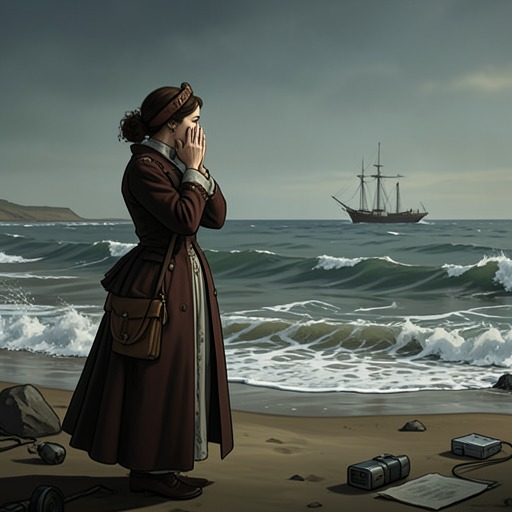
Immortality, Death, and Resurrection
The Moon and the SunImmortality, Death, and Resurrection form a conflict among incompatible meanings of life beyond death: the king’s hope that his own life can be prolonged, the Pope’s promise of everlasting life in God, and the Sea Woman’s account of loss, in which individuals die and do not come back. Marie-Josèphe de la Croix stands between these claims, translating grief through song and exposing how differently the human and sea people understand what it means for life to continue.
Three meanings of everlasting life
The idea of immortality first appears as a royal hope for personal survival. During a dance, Louis XIV speaks of youth and glory returning and says that Yves de la Croix will bring them to him. Marie-Josèphe forces herself to smile and concentrate on the dance, but inwardly fears the moment when the King discovers that Yves cannot help him live forever. His expectation turns a political and familial promise into something more absolute: the restoration he longs for includes escape from mortality itself. The scene does not establish that Yves has promised such a power; it records Marie-Josèphe’s fear that the King expects him to possess it.
The exchange later before the King and Pope Innocent distinguishes bodily survival from religious immortality. Asked whether the Sea Woman claims to be immortal, Marie-Josèphe answers, “No, Your Majesty.” The reply is important because it corrects the assumption that her account of life concerns an individual who cannot die. The Pope then invokes life everlasting in God and asks whether the Sea Woman believes in the Resurrection. The question places her experience inside a Christian framework, but her story, as Marie-Josèphe renders it, does not offer that framework’s assurance that the dead return.
Grief and the irreversibility of death
The Sea Woman’s account gives the debate its intimate, painful substance. Its images follow her dead friend sinking into darkness amid luminous sea creatures, while the Sea Woman cuts a lock of the dead friend’s hair with a shell blade. The scene is not an abstract argument about what happens after death: it presents mourning as an action performed for someone who is gone. Marie-Josèphe watches through the song’s images, with tears blurring her vision and sketch, and fears that the Sea Woman herself intends to die. The possibility of another death gives the act of remembering an immediate, personal urgency.
Marie-Josèphe joins the Sea Woman’s melody and sings, “I would send it with him,” describing the wish to send the hair into the depths with the dead and acknowledge that she, too, will die. The gesture connects remembrance to mortality: the hair is something that can accompany the dead, while the living speaker recognizes her own death as inevitable. The song does not turn grief into a promise of reunion. Instead, its beauty carries the knowledge that love persists in the living even when the beloved does not return.
Resurrection and the dispute over return
The Pope’s question about Resurrection makes the difference between the Sea Woman’s story and Catholic teaching explicit. He speaks of immortality through the love of God and everlasting life, then asks whether the Sea Woman believes in that promised return. Marie-Josèphe answers in harmony with the song: “Life itself is everlasting,” followed by the sequence, “People live, people create new life, people die. People never come back.” The wording holds two claims together. Life continues, but not as the return of the individual who has died; continuity belongs to living and creating new life, while death remains final for each person.
That distinction explains why the exchange becomes more than a disagreement over terminology. The Pope hears the answer as a challenge to religious belief and condemns it as reaching the edge of heresy. Marie-Josèphe insists that she did not invent the story and asks him to believe that the Sea Woman told it, adding that the Sea Woman does not understand heresy. Her defense separates the act of carrying a testimony from endorsing or fabricating it. Yet translation cannot prevent the song’s meaning from colliding with the doctrine through which the Pope judges it.
Marie-Josèphe as interpreter
Marie-Josèphe’s role is neither that of a detached observer nor that of an authoritative theologian. Her fear for the Sea Woman, her tears over the dead friend, and her effort to sing the account in harmony make the exchange an act of empathetic interpretation. She gives the Sea Woman’s grief a form the court can hear, but the Pope’s response shows the cost of making that experience intelligible in a setting governed by religious authority. The Sea Woman’s words are received as a proposition about resurrection even though Marie-Josèphe presents them as a story told by someone who does not share the category of heresy.
Across these encounters, the King’s wish to outlast death, the Pope’s promise of life everlasting, and the Sea Woman’s insistence that the dead do not come back remain distinct rather than reconciled. The contrast gives the concept its force: longing for endless life may mean preserving one powerful person, trusting in divine salvation, or recognizing that life continues only through those who remain and the new life they create. Marie-Josèphe’s song preserves the Sea Woman’s grief without converting it into either the King’s fantasy of personal survival or the Pope’s doctrine of return.